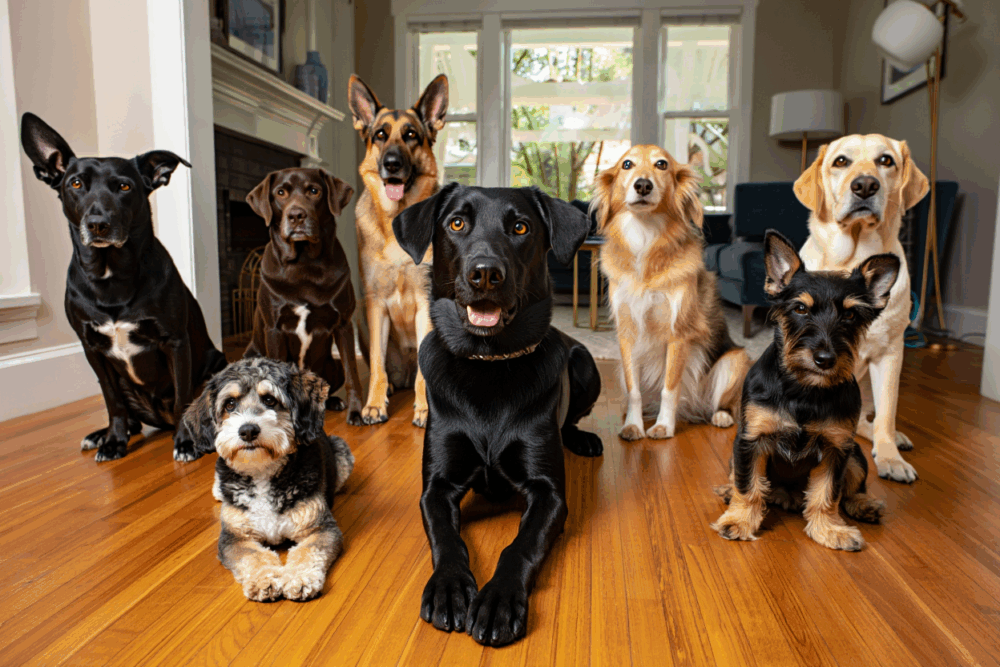
After my beloved furry family members undergo professional dog obedience training, they get to go on vacation with us to receive the final test of our family’s initiation. One of the most basic puppy training commands in our family is learning how to “stay home”.
Before we delve into how our family teaches the stay home command, let’s review some of the most basic puppy training commands. Here are a few below:
- Come
- Sit
- Down
- Stay
- Leave it
- Heel
- Drop it
- Stand/sit pretty
- Kisses
- Off
- Wait
- Watch ‘em
- Leash manners
- Back
- Fetch/Bring it
- No jump
- Potty outside
- Poop outside
The following are some additional commands that I have taught Lucy (Labrador/Pitbull/German Shepherd mix):
- High five
- Gimme your left paw
- Gimme your right paw
- Let’s go to work
- Wanna go bye-bye?
- Get to work
- Tell me
- I love you (she howls this perfectly!)
According to the experts at the American Kennel Club (AKC), they suggest, “Teach Your Puppy These Five Basic Cues:
- Teach Your Dog to Come When Called
- Teach Your Dog Loose-Leash Walking
- Teach Your Dog Sit
- Teach Your Dog Down
- Teach Your Dog Stay
The AKC goes on to explain that, “To start off on the right foot (and paw!), your pup needs to know what you expect. Knowing what is expected makes puppies feel secure in their ability to meet the goals laid out going forward.
The foundation of training should be based on positive reinforcement.
Avoid using punishment such as leash corrections or yelling. Punishment can cause a dog to become confused and unsure about what is being asked of them.
Reinforcement can be anything your dog likes. Lavish praise or the chance to play with a favorite toy can also be used as a reward. Food is often the most convenient way to reinforce behavior.
Puppies can begin very simple training starting as soon as they come home, usually around 8 weeks old. Always keep training sessions brief—just five to 10 minutes—and always end on a positive note,”.
What is the hardest command to teach a dog?
In my humble opinion, as a veteran dog owner, I have found that teaching our lovable furry friends how to go potty outside is by far the hardest and yet, probably the most important command to teach them from the very beginning.
Later on, as they get a bit older, we teach our family K9s how to stay home. Stay home to us means that they must stay close to us, wherever we are. Whether we are on a hike in the woods, camping in the forest, or spending time at our friend’s family cottage, they learn to stay near us, without a leash.
First, we start by keeping them on a leash, walking them within boundaries, and stating where home is. Then the big test – we set them free (not near a major road or highway, of course) and let them learn where home is.
Recently, we went up north Michigan to stay in a rented cabin near Silver Lake Sand Dunes in the town of Mears. The cabin was perfect for us: my cousin, my adult son, my teenage son, and, of course, our lovable furry K9, Lucy. In fact, they even had a dog run! However, we did not need to use it because our little Lucy learned quickly how to stay home, with zero escape attempts.
She was a natural! It was also Lucy’s fourth birthday during our stay, so we made her a pancake and brought her a doggie ice cream cone. So far, all of my dogs have been successful at staying home. Perhaps it is our training style? Or, maybe it is because they have it so good with us that they wouldn’t dare to leave. Either way, we have had success with the following dogs:
- Josi
- Roxy
- Luke
- Lucy
Clio and Phobe were not as successful. Clio, we believe, was possibly mentally disabled as she had quite a few quirks about her. On the other hand, Phoebe was intelligent and a great hunter. Although she loved us dearly, she could not control her urges to go after rabbits, squirrels, chipmunks, cats, other dogs, and even bugs; thus, Phoebe did not stay home well.
Then there was sweet, lovable Otis. He did not get to live with me long enough to learn how to stay home because he went to live with my ex-husband after our divorce.
The Pet Palace states that these are “The Hardest Tricks to Teach Dogs Certain tricks challenge dogs more than others, requiring higher levels of focus, coordination, and sometimes even physical ability. These tricks often involve complex movements or behaviors that take time to master, especially for younger dogs that are still learning the ropes.
Some of the hardest tricks to teach dogs include:
Roll over – To be successful, a dog must learn to roll completely over, which requires flexibility, balance, and coordination
Play dead – This trick involves a dramatic “dead” pose, which can be tough for dogs to master as it requires them to remain still and stop their natural energy
Back up – Teaching a dog to move backward on command goes against their natural instincts to move forward, requiring extra focus and patience
Speak and quiet – Training a dog to bark on command and stop barking when told to requires control over a natural behavior, which can be challenging for excitable dogs
Heel – Getting a dog to walk in perfect sync with you without pulling on a leash can be difficult, especially for high-energy dogs who want to explore
Fetch specific items – Taking things a step beyond simple fetching, a dog must differentiate and fetch specific objects by name, requiring both recognition and memory skills,”.
Unique tricks to teach your dog
Before my beloved Phoebe passed away last year from spleen cancer at only seven years old, she had a litter of pups when she was four years old with our German Shepherd, Otis. One of those puppies is our sweet Lucy. Another pup, Lucy’s sister, Whitney, was adopted by my cousin, who is only four days younger than I, and he adores Whitney!
My cousin has taught Whitney many commands and tricks, including fetching certain items. For example, he taught Whitney how to retrieve a beer and bottled water from the refrigerator, as well as how to find slippers for him and his wife. Not only can Whitney fetch these items, but she also knows the difference between beer and water, and which slippers are whose.
I know Labradors and Pitbulls are smart, but I really believe it is the highly intelligent German Shepherd breed that makes them easy to train.
Basic puppy training commands
In conclusion, mastering basic commands will strengthen the bond between you and your puppy, ensuring a well-behaved companion. Consistency, patience, and positive reinforcement are key to successful training.